I mentioned to my host brother that I was going to meet up with some girls I wanted to impress and he offered me his moto for the night. Needless to say, I obliged his hospitality and accepted. He gave me the keys and a goofy helmet and I was gone. I left ten minutes late and tried to time it so that I would make a grand entrance: while I was puttering my way there I was busy imagining whipping off my helmet to gasps, squeals of delight, and maybe even a little bit of applause.
However, before I can go any further with this story I need to explain how and why I am currently in possession of a magic token. Four or five days ago my host mother presented me with a buckeye nut. It is brown and smooth and shiny and feels and looks exactly like a magic token should. She told me that her father (who is 91 and she visits every day in the hospital) used to always give her buckeye nuts to carry, saying they were good luck. In and of itself, her giving me one was a very sweet and thoughtful gesture. The strange part is that when I was little my Argentine grandfather would give me buckeye nuts as well, and he also said they were for good luck. Actually, he would say something in thick, heavy Spanish that my mother would then translate, but regardless, the nuts were for luck.
What makes it weirder is that these nuts are one of the few things I actually remember about my grandpa. I remember the thick, heavy accent and I remember how he smelled old (in retrospect, I think it was his aftershave). I also remember how his drooping mustache reminded me of a walrus and how his whiskers were as stiff as the bristles of a toothbrush and would scratch against my cheek when he kissed me.
But really, more than just about anything else, I remember the smooth, brown, gnarled, shiny, hard buckeye nuts he would give me before he smiled his toothy grin, like they were a secret just between us.
Because of this, when my host mom gave me one and I held it in my hand, I was both thankful and a little caught off guard. It reminded me of whiskers and aftershave and I started carrying it in my pocket because that’s where it seemed like it belonged. Then I promptly forget it was there.
Now we get to the night of correfoc, where I had foolishly taken my camera. Not only did I have the fire to contend with but I also had to watch out for an endless mob of Barcelona (city with the most thieves in the world) residents out to enjoy the night. I eyed up suspicious characters; I shielded my camera from the fire with my body; I held it like it was a baby, and an expensive one at that.
In short, I was vigilant and responsible, and after correfoc we went to a bar for a beer to celebrate our casualty free fire-run. My friends put their jackets down in the corner where we were playing darts and I hid my camera under them. When I got my beer I talked to bartender for a while because I recognized his Argentine accent. I introduced myself, tipped him well (tipping is not customary in Spain and I don’t normally do it), and left. We finished our game of darts, my friends grabbed their jackets, and we went on our way. When I was already across the street I heard somebody yelling my name: it was the bartender and he was holding my camera.
I thanked him hugely, shook his hand many times, and gave myself a minute to contemplate how phenomenally stupid I am-- it was hardly enough time.
God had I been lucky. What if anybody else had seen the camera first? What if I had gotten a different bartender? What if I hadn’t tipped, or hadn't asked his name? If I were to play the scenario out a thousand times more, I’m not sure I would ever get the camera back again.
Then I remembered—the nut!
I pulled it out of my pocket triumphantly and showed the girls I was with (and would later feel inclined to drive a moto to impress). I explained how and why the buckeye was lucky and gathered two things from their reactions.
First, they clearly didn’t believe that the nut was actually magic.
Second, they definitely thought it was weird that I carried it in my pocket.
I handed it to one of the girls and told her to hold it for a little while. When I took it back I said that now, if she looked for it, something lucky would happen to her in the next couple days. I didn’t know if I was kidding and neither did she.
The next night when I saw her she was excited:
“The nut,” she said, “it works!”
She told me she had been in a cab with her friend and had left her phone in it. The cab driver had heard her call the friend she was with by her name so when he found the phone he had looked up the friend's name in her contacts, called her, and promptly arranged to meet up and return the phone. Now that's service.
“Told you,” I said to her.
So, back story established, let's go back to me puttering along on my host-brother’s moto, dreaming big dreams about small things. Then there’s a forgotten turn signal, and a siren, and two cops asking for license while I try to casually figure out how the hell the kickstand works on this god-damn-good-for-nothing-going-to-put-me-in-Spanish-jail moped.
I decide my chances are better if I don’t speak Spanish. They ask me if I know what I did and I answer with the name of the street where I live. They ask me if I know where the turn signals are on the bike—-I don’t-- and I tell them that I’m. a. student. at. the. University. here. to. practice. my. Spanish.
They exchange glances and it seems to me like they’re in a hurry.
They have no idea what to make of a Delaware driver’s license. They ask me if I have my passport—I don’t—and I hand them my credit card.
They look at each other again.
Have you been drinking one asks me, slowly, leaning in to smell my breath.
“No, sir” I say, and it’s the truth.
“Have you been smoking?” the other asks. He brings his forefinger and thumb together, holds them to his lips, and inhales.
“No, sir” I tell him, holding eye contact. That's true, too.
They turn towards each other and talk deliberately quickly. One asks the other what they should do. He says they should fine me: it’s 200 Euros. The first says he doesn’t even know how to fill out the paperwork for somebody with my license. The other agrees, and says it will be a pain since I don’t understand what’s going on and they will need to bring in another cop who speaks English.
I nod and smile the smile of the good natured but dim foreigner.
They're quiet for a little while, look at each other again, and then nod a nod to one another that lets me know I've gotten off the hook. Phew.
They turn towards me and speak very slowly:
"This was your first and last free pass," one says.
"Drive safe," says the nicer one.
I keep nodding and they turn and walk back to their car.
“Buenas noches señores,” I yell, a little too excited, but my grin is real now.
They look back and smile at me like I'm funny, get into their car, and drive away. I wait until they’re through the next traffic light before I start the bike up because I still have no fucking clue how to work the turn signals.
I reach into my pocket and touch the buck-eye to make sure it’s still there. Of course it is: I’m too lucky to lose it.
Wednesday, September 28, 2011


Monday, September 26, 2011
Last night I went to correfoc.
In Catalan corre means run and foc means fire. Together, in English, they mean fire-run. It was part of the closing day of the festivals of Mercè, a celebration of the patron saint of the city that is said to be the wildest weekend of the year. There is no way correfoc would be legal in the United States. There is no way it should be legal here.
I wore shorts and carried a camera because I did not appreciate how crazy Catalans are: I was spectacularly underdressed and underprepared. Everybody else showed up wearing hats, scarves, hooded sweatshirts, long pants, and ski goggles or sunglasses. Floats decorated like dragons and people dressed like demons went up and down the street shooting off fireworks and giant sparklers. There was loud music. People screamed. There was a lot of fire and at least as much running. It was a bizarre and exhilarating experience.
The sparks burnt my bare legs and a couple times strangers brushed smoldering embers out of my bird’s nest head of hair. When it was all over I realized how many holes had been burnt through my shirt. I also realized I now had a way cooler shirt.


I wore shorts and carried a camera because I did not appreciate how crazy Catalans are: I was spectacularly underdressed and underprepared. Everybody else showed up wearing hats, scarves, hooded sweatshirts, long pants, and ski goggles or sunglasses. Floats decorated like dragons and people dressed like demons went up and down the street shooting off fireworks and giant sparklers. There was loud music. People screamed. There was a lot of fire and at least as much running. It was a bizarre and exhilarating experience.
The sparks burnt my bare legs and a couple times strangers brushed smoldering embers out of my bird’s nest head of hair. When it was all over I realized how many holes had been burnt through my shirt. I also realized I now had a way cooler shirt.


Sunday, September 25, 2011
I’ve conceded, decided, and realized that both the quality and quantity of my posts has decreased since I’ve come to Spain.
I believe this is because I am no longer truly traveling. Rather, I am living in another country. I have a mother here who cooks me nice, hearty meals. I have a brother whose Macbook charger I sometimes borrow. I have a university where I take classes that except for the language difference are much the same as the classes I take back home. Really, I am enjoying myself immensely.
I read a lot. I practice my Spanish. I write some short stories. I drink coffee or a beer outside cafes in the late afternoon and watch the people who walk by and imagine who they are. I’ve become used to girls in high heels that drive mopeds and the noise in the streets when Barca has a soccer game (sorry, fútbol). It is all very charming and interesting but I don't know if I'd call it thrilling. That’s okay. That’s fine. Actually, that’s great: I’m having a safe, enriching, and wholesome intercultural experience. But in having this, in being here, I am in no way unique or, for that matter, particularly interesting.
I’m a college kid whose parents can afford to send him abroad (speaking of which-- mom, dad: thanks!). I can write, but I need something to write about.
So, where does this leave us? What exactly am I saying? Am I quitting the blog? Bowing out early? Going all Bjorn Borg on you guys?
Not quite.
I just want to be candid with what my intentions are moving forward. When I started this, there were a couple things I wanted to get out of it.
First, I wanted to let friends and family know what I was up to. When you could all read and experience some of what I had seen and done, it made me feel like you weren’t quite as far away, and that felt good.
Second, I wanted to document my travels and practice my writing. The public nature of something like a blog encouraged this. I was motivated to keep writing because people kept reading what I wrote, so thank you all for that.
Third, I wanted to see if I could make this any more than those first two pieces-- and in some ways I think I have. To all of you I’ve never met in countries I’ve never been to: hello, I’m Curtis Lee. It took me a while to show a picture with my face on it not because I enjoyed anonymity (I did) but because I didn’t want you all to realize how young I am (almost 21). I thought it would invalidate the whole enterprise but so much for that I suppose.
Still, I haven’t come any closer to answering my question: where does this leave us? What’s going to change?
Not much. So far this has pretty exclusively been a travel blog (of sorts) except for that awkward pubescent stage when it was a quotes blog (of sorts). Now, it’s neither. It’s just my blog. Hopefully I’ve written enough interesting things that you all trust me to keep doing so, and if this means changing the focus a little, I hope you can deal with that. If you can’t, I probably never entertained you much anyways. I’ve been writing some fiction so now and then I’ll be tossing that up here—something I already tested out the waters with a couple days ago. And absolutely I’ll keep writing about when I travel or experience something interesting and different. And then, just to give myself more than a little liberty, I might also write about just about anything else: how I’m feeling, a thought, a quote, etc.
The title Wayward Gentry is not supposed to be an idea or a style or a clever disparate combination of two words. Rather, I think it describes a certain group of people. I would like to think and certainly like to say that money does not mean a whole lot to me, and it doesn’t. But I’m silly and naïve and plain stupid if I think that I could be where I am right now, writing what I am, if I hadn’t had parents who were willing to invest the capital to cultivate me to do so.
There is a strange paradox between wealth and freedom. Having money grants you liberty, but in order to gain the liberty that comes from being able to buy yourself a little chunk of land where you are autonomous enough that you can tell the rest of the world to go fuck itself, you have to sacrifice a lot of that freedom and go out into the world to make enough money to buy the chunk of land in the first place. Here’s where the children of wiser parents who have already confronted and compromised and done something with their lives come in: the kid only gets plugged into half of that equation, at least until they’re self-sufficient. This is why it is so damn easy for us (us being the kids) to talk about ideals and values and how we’re going to live our lives—we haven’t lived them yet; we haven’t had to compromise ideals; and we haven’t had to blemish our values. We stand on a hill in a flood and yell about how people should be bailing water.
It’s hypocritical and stupid, yes, but it’s also exactly what we should be doing at this age. Because if we don’t, if we don’t question the system and how it functions and who pedals the million little bikes that makes the one great wheel turn, well then, we’re just going to buy into the whole thing in bulk without choosing which ideals we are not willing to compromise and which values we are unwilling to blemish.
That is exactly why it’s important that we are wayward, that we get out and see the world and begin to understand how different and the same all of it really is. It makes us question and think about and decide which ideas and beliefs truly belong to us and which are just a part of what we’ve been taught and told and taken for granted. The two are not the same (unless you attend Vanderbilt University, zing!) and it's up to each of us to figure out where they're different.
So, if you were wondering, that’s what I think of the title to mean-- the name is an oxymoron and difficult to reconcile but then again, so is a lot of growing up.
I read a lot. I practice my Spanish. I write some short stories. I drink coffee or a beer outside cafes in the late afternoon and watch the people who walk by and imagine who they are. I’ve become used to girls in high heels that drive mopeds and the noise in the streets when Barca has a soccer game (sorry, fútbol). It is all very charming and interesting but I don't know if I'd call it thrilling. That’s okay. That’s fine. Actually, that’s great: I’m having a safe, enriching, and wholesome intercultural experience. But in having this, in being here, I am in no way unique or, for that matter, particularly interesting.
I’m a college kid whose parents can afford to send him abroad (speaking of which-- mom, dad: thanks!). I can write, but I need something to write about.
So, where does this leave us? What exactly am I saying? Am I quitting the blog? Bowing out early? Going all Bjorn Borg on you guys?
Not quite.
I just want to be candid with what my intentions are moving forward. When I started this, there were a couple things I wanted to get out of it.
First, I wanted to let friends and family know what I was up to. When you could all read and experience some of what I had seen and done, it made me feel like you weren’t quite as far away, and that felt good.
Second, I wanted to document my travels and practice my writing. The public nature of something like a blog encouraged this. I was motivated to keep writing because people kept reading what I wrote, so thank you all for that.
Third, I wanted to see if I could make this any more than those first two pieces-- and in some ways I think I have. To all of you I’ve never met in countries I’ve never been to: hello, I’m Curtis Lee. It took me a while to show a picture with my face on it not because I enjoyed anonymity (I did) but because I didn’t want you all to realize how young I am (almost 21). I thought it would invalidate the whole enterprise but so much for that I suppose.
Still, I haven’t come any closer to answering my question: where does this leave us? What’s going to change?
Not much. So far this has pretty exclusively been a travel blog (of sorts) except for that awkward pubescent stage when it was a quotes blog (of sorts). Now, it’s neither. It’s just my blog. Hopefully I’ve written enough interesting things that you all trust me to keep doing so, and if this means changing the focus a little, I hope you can deal with that. If you can’t, I probably never entertained you much anyways. I’ve been writing some fiction so now and then I’ll be tossing that up here—something I already tested out the waters with a couple days ago. And absolutely I’ll keep writing about when I travel or experience something interesting and different. And then, just to give myself more than a little liberty, I might also write about just about anything else: how I’m feeling, a thought, a quote, etc.
The title Wayward Gentry is not supposed to be an idea or a style or a clever disparate combination of two words. Rather, I think it describes a certain group of people. I would like to think and certainly like to say that money does not mean a whole lot to me, and it doesn’t. But I’m silly and naïve and plain stupid if I think that I could be where I am right now, writing what I am, if I hadn’t had parents who were willing to invest the capital to cultivate me to do so.
There is a strange paradox between wealth and freedom. Having money grants you liberty, but in order to gain the liberty that comes from being able to buy yourself a little chunk of land where you are autonomous enough that you can tell the rest of the world to go fuck itself, you have to sacrifice a lot of that freedom and go out into the world to make enough money to buy the chunk of land in the first place. Here’s where the children of wiser parents who have already confronted and compromised and done something with their lives come in: the kid only gets plugged into half of that equation, at least until they’re self-sufficient. This is why it is so damn easy for us (us being the kids) to talk about ideals and values and how we’re going to live our lives—we haven’t lived them yet; we haven’t had to compromise ideals; and we haven’t had to blemish our values. We stand on a hill in a flood and yell about how people should be bailing water.
It’s hypocritical and stupid, yes, but it’s also exactly what we should be doing at this age. Because if we don’t, if we don’t question the system and how it functions and who pedals the million little bikes that makes the one great wheel turn, well then, we’re just going to buy into the whole thing in bulk without choosing which ideals we are not willing to compromise and which values we are unwilling to blemish.
That is exactly why it’s important that we are wayward, that we get out and see the world and begin to understand how different and the same all of it really is. It makes us question and think about and decide which ideas and beliefs truly belong to us and which are just a part of what we’ve been taught and told and taken for granted. The two are not the same (unless you attend Vanderbilt University, zing!) and it's up to each of us to figure out where they're different.
So, if you were wondering, that’s what I think of the title to mean-- the name is an oxymoron and difficult to reconcile but then again, so is a lot of growing up.
Sunday, September 18, 2011
Maybe What Will Be Once Was
It had started as a sort of joke, a dare even. After the party had wound down and everybody else had either left or passed out, after he had kissed her once, and released the tension that had built, making everything obvious and exciting and new, after all that, he had looked her in the eyes and told her that they should watch the sun rise on the beach.
They were sitting on the counter amid the ruins of half full red cups and spilt beer, passing back and forth a bottle of cheap champagne they had found hidden in a cabinet. When he had popped the plastic cork the champagne had foamed up and overflowed and he had tried to drink it as fast as it came out while she laughed at him in a way that let him know he had already won. He had to be careful not to hurt this one; she was sweet.
“Okay,” she had said, grinning, “let’s”.
So they waited and talked and drank as the night grew late and they grew tired and then it was almost time and they woke up some because it had become clear that it was no longer a joke or a dare but something that they were really going to do. She had become a little drunk and they were still on the counter, side by side, legs touching and shooting sparks and warmth through each of them, and she looked at him sincerely and studied him, furrowing her eyebrows in a way she wouldn’t have if she were sober.
“What?” he said.
She turned straight ahead again and smiled to herself. She kicked her toes up in the air and brought her heels back against the cabinet beneath her so softly they hardly made a sound.
“Oh, nothing” she said.
He reached around her with his left arm and tickled her stomach where it met her hip. It was firm and smooth and she giggled.
“What?” he said again, but he already knew what it was and this was part of the game, too. She grabbed his hand tight to make him stop and then wrapped her fingers around his.
“Nothing,” she said, softer now, “I’m just trying to figure you out.”
He smiled at her.
“And what are you coming up with?”
“I don’t know,” she said.
“Maybe there’s nothing to figure out,” he said.
“I don’t believe you.”
“I don’t know what you’re talking about,” he said.
“Shut up,” she said, “you do too.”
“Do I?” he asked, moving his hand in hers, his fingers around hers, through hers, like a person following a light out of a tunnel. “And what would that be?”
“That you’re not like other guys,” she said.
He waited.
“You’re different,” she said.
“How am I different?” he asked.
“I don’t know,” she said. “Just different.”
He took another swig of the champagne and finished it. He turned sideways, felt sideways, and looked at her.
“Maybe you don’t know the right guys,” he said.
“I know enough,” she said. “They’re all assholes.” She scrunched up her nose. “Or little boys.”
“And I’m an asshole?”
“That one I’m still trying to figure out,” she said.
“You are?” he asked.
“I am,” she said.
“I’m not a bad guy.“
“I know," she said.
They were silent and looked at each other and he leaned in and kissed her, gently, running the fingers of his left hand through her hair. He bit down softly on her lower lip and pulled away while her eyes were still closed.
“You’re still sure?” he said, grinning.
“No.” she answered, with a little shake of her head, “but I like you.”
“Well,” he said, “the asshole likes you too”.
“Stop it,” she said, raising her voice and leaning into him. “I only meant that I don’t know what to make of you.”
“Do you know why?”
“Why?”
“Because you’ve never met a guy like me before.”
“And how do you know that?” she asked.
“I just do.”
“How?”
“I just do.”
“And what makes you so sure?”
“The fact that you ask me how I know like I’m right.”
“Asshole,” she said, but she was smiling.
“At least that’s better than a little boy, right?”
“Who said you’re not a little boy?”
“Me.”
“So you’re a man?”
“Yes.”
“And you’re sure?”
“Yes.”
“What makes you a man?”
“The fact that I comport myself like one.”
She paused. “What does comport mean?”
“It means act,” he said.
“So you think you act like a man?”
“I know so.”
“And how do you act like a man?”
He waited, looked forward, thought.
“You act like a man by being soft in the right places and hard in all the rest.”
She thought about it. “I like that,” she said. “Maybe it’s the opposite for a woman.”
“Yes,” he said. “Maybe.”
They were silent for a while and then he leaned over and kissed her again.
“So,” he said, “Am I still an asshole?”
“I’m going to go with yes,” she said.
“What makes me an asshole?” he asked.
“Well, first, you seem awfully concerned with being one, and second, you’re cocky.”
“I’m cocky?”
She smiled. “A little, but it’s a good thing. Girls like cocky guys.”
“I’m not cocky,” he said.
“Oh, yeah?”
“I’m confident. There’s a difference.”
“Fine,” she said, leaning in to kiss him. “You’re confident.”
He leaned back, keeping his face just apart from her's.
“And I’m not an asshole because I’m confident.”
She leaned towards him, over him. “And you’re not an asshole because you’re confident.”
He lay all the way back on the counter.
“Good,” he said.
She brought her nose against his.
“Good” she said. “Now kiss me already.”
He pulled her down into him and kissed her until she breathed in deeply through her nose and grabbed his shirt and pulled him up towards her and kissed him hard.
When they stopped, he had a big smile on his face.
“See?” he said, “I’m not cocky, I’m just very good at this.”
“Yeah?” she asked, “What’s this?”
He looked at her like he couldn’t believe she didn’t know.
“Seduction, of course.”
She laughed. He liked the way she laughed.
“Oh, really? Is that what you’re doing?”
“That’s exactly what I’m doing.”
“I wasn’t aware,” she said.
“That’s because I’m subtle.”
“Don’t forget modest,” she said.
“You’re right,” he said, “and modest, too.” He put a hand on her knee. ”Now, let’s go to the beach.”
He saw her furrow her eyebrows for the slightest of seconds before she leaned over, pecked him on the cheek, and hopped off the counter too.
“Okay,” she said. “Let’s.”
So they walked out of the sleeping house into the quiet streets, bringing blankets that they dragged behind them for a cold they didn’t feel. It was a couple of blocks but it felt like a long way and she reached out and held his hand and it seemed to each of them that they had known the other for a long time, or at least for longer than the night.
When they got to the wooden bridge that led out over the dunes past the scrub grass below and down to the beach they kicked off their shoes and left them there, feeling the cool sand between their toes and the coarse boards underfoot as they walked towards the sound of the ocean.
The feeling had been there for him before, when they were inside, but now he knew and recognized that it was gone, like it always was by now, even if it had lasted longer than normal with this one. That was something at least, he thought. So he pretended, which was almost as good but also entirely different. He looked at her in the dark and she was beautiful, yes, but also simple and untroubled and transparent in her dreams and in that moment he knew he would eventually destroy her. He saw it all in a flash: he would be good to her and reciprocate the love she gave, a love of the sort she hadn’t been able to give away before and a love of the sort it would take her a long time to give away after, and she would give more and more of herself, not knowing she was taking back nothing in return because he had nothing in return to give, and he would want to reach out and save her but his throat would be dry and no words would come— he would be hoarse and sputter and try to find the right sounds to let her know—but it wouldn’t be enough and it would be too late. He would be numb and apathetic and she would grow to understand he had always been that way and that it was this in the end that had broken her. She would hate him for it.
He wanted to change it, to run, to save her, but he knew that it had always been like this, that it would always be like this-- there was never any choice involved, and there never would be.
But then the flash, which was more of a feeling, was gone and there was only the cool night air and the stars overhead and her hand in his, looking for something that wasn’t there.
So they walked down to the waves, their blankets erasing their own footsteps in the sand as they dragged behind them.
They came to the water and the sand became moist and cold and hard. He waded out to his knees; she stuck a toe in.
“It’s freezing,” she said.
“It’s nice,” he said. Then, after a while, “the ocean reminds me of eternity.”
She didn’t know what to say.
He lowered his hands to where his fingertips touched the water. The two of them were silent and each listened to the waves, apart.
“It’s cold and huge and indifferent and it never starts or stops moving,” he said. “And it’s beautiful too, but that has nothing to do with eternity because what we call beauty is a part of us, not it.”
“Why are you interested in me?” she asked.
“What do you mean?” he said. He didn’t turn around.
“You’re smarter than me, and I’m not that pretty, and I’m not going to sleep with you anytime soon... especially not tonight, in case you were wondering.”
She watched his silhouette against the sea as the waves rolled in and out.
“It looks like the ocean is breathing,” he said.
He bent over and slowly lifted his hands through the black water.
“You’re smarter than you give yourself credit for,” he said.
“I’m complicated,” she said.
“That’s okay,” he said. “Me too.”
“I have problems trusting guys,” she said. “I’m a lot of work.”
“That’s okay, too,” he said. “I’ll win you over.” He craned his head back and looked at the night sky and pointed. “You can see the moon through those clouds over there.”
“Why are you so sure you can have me?” she said.
“I don’t know,” he said. “I just feel like we’ve done this before.”
She felt the air go out of her chest.
“You’re strange,” she said, “you know that, right?”
She was almost crying and she didn’t know why.
“I know,” he said.
He turned around and walked out of the water and she spread one of the two blankets out up and a little away from the line in the sand where the rolling water stopped. As she was lying down on it he suddenly pushed her and she thudded down and he lowered himself over her, holding himself up with his arms. He kissed her and she pulled him towards her with his belt loops and lifted her hips against his and wanted him and wanted to tell him no all at the same time.
After a while, he moved over onto his side and rested on his elbow and brushed a strand of hair off her face with his other hand.
“You’re very pretty,” he said.
She bit her lower lip.
“Stop,” she said.
“No,” he said, and leaned over and kissed her forehead.
The waves rolled in and out. To him they sounded like a mother calming her child. To her they sounded like whispers.
“Please don’t hurt me,” she said.
They were silent for a long time and he tried to think of something to say but nothing came. He rolled onto his back and put an arm underneath her head. She laid her legs over and across him.
“Stop thinking so much,” he told her.
“I can’t,” she said. Then, after a while, “how much longer till the sun comes up?”
“Soon,” he said, “soon.”
“Good,” she said. “I’m tired.”
With that, she curled herself up against him and fell asleep.
When she awoke he was lightly, barely, tracing his finger up and down the inside of her arm.
“It’s starting,” he said.
And it was. At the bottom of the sky, where you couldn't tell what was air and what was sea, the first rays of pink and purple were slowly bleeding together into the darkness of the night.
They were sitting on the counter amid the ruins of half full red cups and spilt beer, passing back and forth a bottle of cheap champagne they had found hidden in a cabinet. When he had popped the plastic cork the champagne had foamed up and overflowed and he had tried to drink it as fast as it came out while she laughed at him in a way that let him know he had already won. He had to be careful not to hurt this one; she was sweet.
“Okay,” she had said, grinning, “let’s”.
So they waited and talked and drank as the night grew late and they grew tired and then it was almost time and they woke up some because it had become clear that it was no longer a joke or a dare but something that they were really going to do. She had become a little drunk and they were still on the counter, side by side, legs touching and shooting sparks and warmth through each of them, and she looked at him sincerely and studied him, furrowing her eyebrows in a way she wouldn’t have if she were sober.
“What?” he said.
She turned straight ahead again and smiled to herself. She kicked her toes up in the air and brought her heels back against the cabinet beneath her so softly they hardly made a sound.
“Oh, nothing” she said.
He reached around her with his left arm and tickled her stomach where it met her hip. It was firm and smooth and she giggled.
“What?” he said again, but he already knew what it was and this was part of the game, too. She grabbed his hand tight to make him stop and then wrapped her fingers around his.
“Nothing,” she said, softer now, “I’m just trying to figure you out.”
He smiled at her.
“And what are you coming up with?”
“I don’t know,” she said.
“Maybe there’s nothing to figure out,” he said.
“I don’t believe you.”
“I don’t know what you’re talking about,” he said.
“Shut up,” she said, “you do too.”
“Do I?” he asked, moving his hand in hers, his fingers around hers, through hers, like a person following a light out of a tunnel. “And what would that be?”
“That you’re not like other guys,” she said.
He waited.
“You’re different,” she said.
“How am I different?” he asked.
“I don’t know,” she said. “Just different.”
He took another swig of the champagne and finished it. He turned sideways, felt sideways, and looked at her.
“Maybe you don’t know the right guys,” he said.
“I know enough,” she said. “They’re all assholes.” She scrunched up her nose. “Or little boys.”
“And I’m an asshole?”
“That one I’m still trying to figure out,” she said.
“You are?” he asked.
“I am,” she said.
“I’m not a bad guy.“
“I know," she said.
They were silent and looked at each other and he leaned in and kissed her, gently, running the fingers of his left hand through her hair. He bit down softly on her lower lip and pulled away while her eyes were still closed.
“You’re still sure?” he said, grinning.
“No.” she answered, with a little shake of her head, “but I like you.”
“Well,” he said, “the asshole likes you too”.
“Stop it,” she said, raising her voice and leaning into him. “I only meant that I don’t know what to make of you.”
“Do you know why?”
“Why?”
“Because you’ve never met a guy like me before.”
“And how do you know that?” she asked.
“I just do.”
“How?”
“I just do.”
“And what makes you so sure?”
“The fact that you ask me how I know like I’m right.”
“Asshole,” she said, but she was smiling.
“At least that’s better than a little boy, right?”
“Who said you’re not a little boy?”
“Me.”
“So you’re a man?”
“Yes.”
“And you’re sure?”
“Yes.”
“What makes you a man?”
“The fact that I comport myself like one.”
She paused. “What does comport mean?”
“It means act,” he said.
“So you think you act like a man?”
“I know so.”
“And how do you act like a man?”
He waited, looked forward, thought.
“You act like a man by being soft in the right places and hard in all the rest.”
She thought about it. “I like that,” she said. “Maybe it’s the opposite for a woman.”
“Yes,” he said. “Maybe.”
They were silent for a while and then he leaned over and kissed her again.
“So,” he said, “Am I still an asshole?”
“I’m going to go with yes,” she said.
“What makes me an asshole?” he asked.
“Well, first, you seem awfully concerned with being one, and second, you’re cocky.”
“I’m cocky?”
She smiled. “A little, but it’s a good thing. Girls like cocky guys.”
“I’m not cocky,” he said.
“Oh, yeah?”
“I’m confident. There’s a difference.”
“Fine,” she said, leaning in to kiss him. “You’re confident.”
He leaned back, keeping his face just apart from her's.
“And I’m not an asshole because I’m confident.”
She leaned towards him, over him. “And you’re not an asshole because you’re confident.”
He lay all the way back on the counter.
“Good,” he said.
She brought her nose against his.
“Good” she said. “Now kiss me already.”
He pulled her down into him and kissed her until she breathed in deeply through her nose and grabbed his shirt and pulled him up towards her and kissed him hard.
When they stopped, he had a big smile on his face.
“See?” he said, “I’m not cocky, I’m just very good at this.”
“Yeah?” she asked, “What’s this?”
He looked at her like he couldn’t believe she didn’t know.
“Seduction, of course.”
She laughed. He liked the way she laughed.
“Oh, really? Is that what you’re doing?”
“That’s exactly what I’m doing.”
“I wasn’t aware,” she said.
“That’s because I’m subtle.”
“Don’t forget modest,” she said.
“You’re right,” he said, “and modest, too.” He put a hand on her knee. ”Now, let’s go to the beach.”
He saw her furrow her eyebrows for the slightest of seconds before she leaned over, pecked him on the cheek, and hopped off the counter too.
“Okay,” she said. “Let’s.”
So they walked out of the sleeping house into the quiet streets, bringing blankets that they dragged behind them for a cold they didn’t feel. It was a couple of blocks but it felt like a long way and she reached out and held his hand and it seemed to each of them that they had known the other for a long time, or at least for longer than the night.
When they got to the wooden bridge that led out over the dunes past the scrub grass below and down to the beach they kicked off their shoes and left them there, feeling the cool sand between their toes and the coarse boards underfoot as they walked towards the sound of the ocean.
The feeling had been there for him before, when they were inside, but now he knew and recognized that it was gone, like it always was by now, even if it had lasted longer than normal with this one. That was something at least, he thought. So he pretended, which was almost as good but also entirely different. He looked at her in the dark and she was beautiful, yes, but also simple and untroubled and transparent in her dreams and in that moment he knew he would eventually destroy her. He saw it all in a flash: he would be good to her and reciprocate the love she gave, a love of the sort she hadn’t been able to give away before and a love of the sort it would take her a long time to give away after, and she would give more and more of herself, not knowing she was taking back nothing in return because he had nothing in return to give, and he would want to reach out and save her but his throat would be dry and no words would come— he would be hoarse and sputter and try to find the right sounds to let her know—but it wouldn’t be enough and it would be too late. He would be numb and apathetic and she would grow to understand he had always been that way and that it was this in the end that had broken her. She would hate him for it.
He wanted to change it, to run, to save her, but he knew that it had always been like this, that it would always be like this-- there was never any choice involved, and there never would be.
But then the flash, which was more of a feeling, was gone and there was only the cool night air and the stars overhead and her hand in his, looking for something that wasn’t there.
So they walked down to the waves, their blankets erasing their own footsteps in the sand as they dragged behind them.
They came to the water and the sand became moist and cold and hard. He waded out to his knees; she stuck a toe in.
“It’s freezing,” she said.
“It’s nice,” he said. Then, after a while, “the ocean reminds me of eternity.”
She didn’t know what to say.
He lowered his hands to where his fingertips touched the water. The two of them were silent and each listened to the waves, apart.
“It’s cold and huge and indifferent and it never starts or stops moving,” he said. “And it’s beautiful too, but that has nothing to do with eternity because what we call beauty is a part of us, not it.”
“Why are you interested in me?” she asked.
“What do you mean?” he said. He didn’t turn around.
“You’re smarter than me, and I’m not that pretty, and I’m not going to sleep with you anytime soon... especially not tonight, in case you were wondering.”
She watched his silhouette against the sea as the waves rolled in and out.
“It looks like the ocean is breathing,” he said.
He bent over and slowly lifted his hands through the black water.
“You’re smarter than you give yourself credit for,” he said.
“I’m complicated,” she said.
“That’s okay,” he said. “Me too.”
“I have problems trusting guys,” she said. “I’m a lot of work.”
“That’s okay, too,” he said. “I’ll win you over.” He craned his head back and looked at the night sky and pointed. “You can see the moon through those clouds over there.”
“Why are you so sure you can have me?” she said.
“I don’t know,” he said. “I just feel like we’ve done this before.”
She felt the air go out of her chest.
“You’re strange,” she said, “you know that, right?”
She was almost crying and she didn’t know why.
“I know,” he said.
He turned around and walked out of the water and she spread one of the two blankets out up and a little away from the line in the sand where the rolling water stopped. As she was lying down on it he suddenly pushed her and she thudded down and he lowered himself over her, holding himself up with his arms. He kissed her and she pulled him towards her with his belt loops and lifted her hips against his and wanted him and wanted to tell him no all at the same time.
After a while, he moved over onto his side and rested on his elbow and brushed a strand of hair off her face with his other hand.
“You’re very pretty,” he said.
She bit her lower lip.
“Stop,” she said.
“No,” he said, and leaned over and kissed her forehead.
The waves rolled in and out. To him they sounded like a mother calming her child. To her they sounded like whispers.
“Please don’t hurt me,” she said.
They were silent for a long time and he tried to think of something to say but nothing came. He rolled onto his back and put an arm underneath her head. She laid her legs over and across him.
“Stop thinking so much,” he told her.
“I can’t,” she said. Then, after a while, “how much longer till the sun comes up?”
“Soon,” he said, “soon.”
“Good,” she said. “I’m tired.”
With that, she curled herself up against him and fell asleep.
When she awoke he was lightly, barely, tracing his finger up and down the inside of her arm.
“It’s starting,” he said.
And it was. At the bottom of the sky, where you couldn't tell what was air and what was sea, the first rays of pink and purple were slowly bleeding together into the darkness of the night.
Thursday, September 15, 2011
My room is very, very hot.
I wake up every night drenched in sweat. Then I make my way to the subway station where it is nearly as hot and much more humid. When the train comes down the tunnel it pushes the cool air out and over me and for those five seconds I believe in God and hyperbole. But then the train stops, and I get on, and the people next to me are sweaty too. I don’t think Spaniards believe in air conditioners-- my house has one but I am afraid to turn it on. That would be a very American thing to do.
It is considered inappropriate for men to wear shorts out at night. This is a silly and antiquated rule that I have started to violate. I don’t care if I stick out; I can’t do it anymore. If it’s this hot people should be able to wear shorts and that is that, so there, Spain. Inside the clubs that thump with music that reminds you that you are in Barcelona the city is at its hottest, even in shorts. The girls dance and move and glisten but I do not think I glisten. I just sweat and the back of my shirt glues itself to my shoulders. Drops fall off my nose and when I try to talk to the glistening girls I look like a leaky faucet.
I could go on but I am sure that you are cool and comfortable as you read this and thus it must bore you like a war story with too much detail and blood and repetition—I am sorry for that. To make up for it I will tell you about the guy in the wheelchair. I call him wheelchair-man. He was severely debilitated and rather than seem smart and look up what was wrong with him I will say what I would say if I was talking to you and not writing for you: he had that Stephen Hawking thing going on. His head was pressed down and towards his shoulder and his arms jutted up against his body awkwardly. His right hand controlled a small joystick on the armrest.
I saw him near the beach where I was watching a fun Brazilian band playing on the street. They made a lot of noise and yelled a lot and jumped around and smiled while they sang. I was sitting on a curb watching them and smiling too when wheelchair-man started to pass by behind them. He had a large bottle of water attached to the back of his wheelchair and I remember wondering how he got to it. Could he get out of the chair alone? He went a little ways past and then he stopped. He slowly turned around towards the band, making a half circle with a four or five foot radius. He stopped and stayed like that for a while, watching with his head stuck to his shoulder, and then he pushed the joystick forward and came a little closer. He listened a little more, and then came a little closer again.
This went on until he was near the rest of us watching. People in the audience were stamping their feet and some were up and swaying but a lot were just sitting down and watching too. The Brazilian guitarist, every now and then, would jump up and run through the crowd. Wheelchair-man started to fidget with his joystick and shake the chair back and forth a little and I couldn’t figure out what he was doing. Then he did it a bit more, and he started to rock his body back and forth in the chair too. Another song came on and he kept going and then he wasn’t shaking the chair back and forth but driving it around, turning it, spinning it, and doing figure-eights: he was dancing, as best he could at least.
He kept rocking more and more and it wasn’t graceful or pretty because he couldn’t move his body and I was a little afraid he would fall out of the chair but the people in the crowd started to notice him. It seemed to me he was the most earnest man I had ever seen and that all he truly wanted to do, or ever wanted to do, was dance. He was very concentrated. He was smiling too, or making what seemed to me like a smile. The guitarist went over to him and jumped around him and wheelchair-man spun around in circles and now it was clear that he really was smiling and the music was playing louder and another man in the band was yelling into the microphone and it was a moment that made me smile too and I was happy to have been there and for him to have been there and I was happy that he was happy, for whatever that is worth.
I don’t know if there is anything deeper than that in the story, I don’t offer it as a parable or a positive example. It is only something that I saw just off the beach in Barcelona which is a place strange enough for it to have been real. After a couple more songs I got up and left, but he was still there, spinning and dancing, sweaty and thirsty looking.


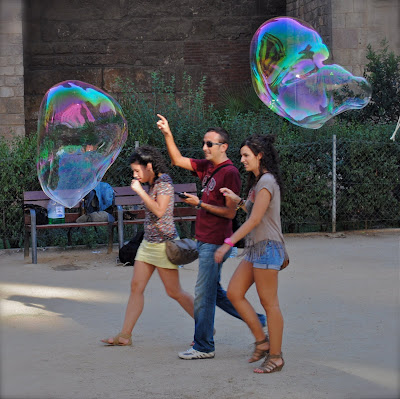

It is considered inappropriate for men to wear shorts out at night. This is a silly and antiquated rule that I have started to violate. I don’t care if I stick out; I can’t do it anymore. If it’s this hot people should be able to wear shorts and that is that, so there, Spain. Inside the clubs that thump with music that reminds you that you are in Barcelona the city is at its hottest, even in shorts. The girls dance and move and glisten but I do not think I glisten. I just sweat and the back of my shirt glues itself to my shoulders. Drops fall off my nose and when I try to talk to the glistening girls I look like a leaky faucet.
I could go on but I am sure that you are cool and comfortable as you read this and thus it must bore you like a war story with too much detail and blood and repetition—I am sorry for that. To make up for it I will tell you about the guy in the wheelchair. I call him wheelchair-man. He was severely debilitated and rather than seem smart and look up what was wrong with him I will say what I would say if I was talking to you and not writing for you: he had that Stephen Hawking thing going on. His head was pressed down and towards his shoulder and his arms jutted up against his body awkwardly. His right hand controlled a small joystick on the armrest.
I saw him near the beach where I was watching a fun Brazilian band playing on the street. They made a lot of noise and yelled a lot and jumped around and smiled while they sang. I was sitting on a curb watching them and smiling too when wheelchair-man started to pass by behind them. He had a large bottle of water attached to the back of his wheelchair and I remember wondering how he got to it. Could he get out of the chair alone? He went a little ways past and then he stopped. He slowly turned around towards the band, making a half circle with a four or five foot radius. He stopped and stayed like that for a while, watching with his head stuck to his shoulder, and then he pushed the joystick forward and came a little closer. He listened a little more, and then came a little closer again.
This went on until he was near the rest of us watching. People in the audience were stamping their feet and some were up and swaying but a lot were just sitting down and watching too. The Brazilian guitarist, every now and then, would jump up and run through the crowd. Wheelchair-man started to fidget with his joystick and shake the chair back and forth a little and I couldn’t figure out what he was doing. Then he did it a bit more, and he started to rock his body back and forth in the chair too. Another song came on and he kept going and then he wasn’t shaking the chair back and forth but driving it around, turning it, spinning it, and doing figure-eights: he was dancing, as best he could at least.
He kept rocking more and more and it wasn’t graceful or pretty because he couldn’t move his body and I was a little afraid he would fall out of the chair but the people in the crowd started to notice him. It seemed to me he was the most earnest man I had ever seen and that all he truly wanted to do, or ever wanted to do, was dance. He was very concentrated. He was smiling too, or making what seemed to me like a smile. The guitarist went over to him and jumped around him and wheelchair-man spun around in circles and now it was clear that he really was smiling and the music was playing louder and another man in the band was yelling into the microphone and it was a moment that made me smile too and I was happy to have been there and for him to have been there and I was happy that he was happy, for whatever that is worth.
I don’t know if there is anything deeper than that in the story, I don’t offer it as a parable or a positive example. It is only something that I saw just off the beach in Barcelona which is a place strange enough for it to have been real. After a couple more songs I got up and left, but he was still there, spinning and dancing, sweaty and thirsty looking.


Saturday, September 3, 2011
I am in a small beach town a couple hours north of Barcelona.
I flew in, took a shuttle to the bus station, and hopped on the first bus headed north they had. I did not know where to get off because I did not remember the name of where I was going. Still, I found my way to an old fisherman's port called Llafranc (whether it is where I originally set off for, I cannot tell you). Tourist season is over and it is very relaxed and beautiful. The sun and the wind play off the water and the bleached white houses. I have my hostel to myself. The owner, a leathery faced man named Enrique, gave me a double room with a balcony for the price of a single. He teaches me which words I learned in Argentina do not translate in Spain. The word I've been using for vagina, for instance, means sea shell here. Thank God I cleared that one up.
I spend my days reading on the beach. At times, if I feel so inclined, I sleep on the beach. The women are mostly topless but I think I prefer my clothed American beach ignorance: all the women who I would normally think have nice boobs have weird nipples here. Maybe normal nipples are not as normal as I thought-- maybe what I consider normal nipples are actually exemplary nipples-- the boob shaped house of cards I've spent my life so carefully building is suddenly crashing down around me.
The sand has too many pebbles in it and the water is a little cold but it is a beautifully clear turquoise that turns to a deep blue as you get further out. I am not a good swimmer and when I get tired I turn onto my back and float easily in the salty water. The water clogs my ears and I can't open my eyes because of the sun but I kick my legs and bow my arms and shoot across the surface like a water spider: I am at one with the sea; I am like foam; I am indestructible and intangible.
I must look silly from the shore.
Yesterday I rented a kayak and went out too far. The man who I rented it from came out on a speedboat and yelled at me in a friendly way. For whatever reason, he was convinced I was kidding him when I said I wasn't German.
Last night I got bored and walked into the the lobby of a fancy hotel because it had an interesting portrait of Dali hung on the wall inside. I struck up a conversation with a nice British couple at the bar and the man offered to buy me a drink. I felt bad having a stranger buy me a fifteen dollar drink and declined.
No, really, he said, what do you want?
I paused, thought, then said a whiskey and coke.
You're learning, he told me.


I spend my days reading on the beach. At times, if I feel so inclined, I sleep on the beach. The women are mostly topless but I think I prefer my clothed American beach ignorance: all the women who I would normally think have nice boobs have weird nipples here. Maybe normal nipples are not as normal as I thought-- maybe what I consider normal nipples are actually exemplary nipples-- the boob shaped house of cards I've spent my life so carefully building is suddenly crashing down around me.
The sand has too many pebbles in it and the water is a little cold but it is a beautifully clear turquoise that turns to a deep blue as you get further out. I am not a good swimmer and when I get tired I turn onto my back and float easily in the salty water. The water clogs my ears and I can't open my eyes because of the sun but I kick my legs and bow my arms and shoot across the surface like a water spider: I am at one with the sea; I am like foam; I am indestructible and intangible.
I must look silly from the shore.
Yesterday I rented a kayak and went out too far. The man who I rented it from came out on a speedboat and yelled at me in a friendly way. For whatever reason, he was convinced I was kidding him when I said I wasn't German.
Last night I got bored and walked into the the lobby of a fancy hotel because it had an interesting portrait of Dali hung on the wall inside. I struck up a conversation with a nice British couple at the bar and the man offered to buy me a drink. I felt bad having a stranger buy me a fifteen dollar drink and declined.
No, really, he said, what do you want?
I paused, thought, then said a whiskey and coke.
You're learning, he told me.


Wednesday, August 31, 2011
Hurricane Irene is coming.
The rain is supposed to start tomorrow evening, around seven, and heavy flooding is expected. If Leigh’s flight hadn’t made it in this morning it would have been cancelled but it did and he is here. This dinner is for him actually—a sort of welcome home celebration. It is also a goodbye—he leaves for Spain on Wednesday. His mother is in town to see him and she has convinced his father that rather than fight over who gets this first night back they should share it, everybody together. With Lauren and her kids, and Leigh’s sister taking the train in from Philadelphia, the reservation is for seven. They have never done anything everybody together before.
Both of Leigh’s parents are still members at the club and as he drives there, no more than half a mile from his father’s house, he wonders if the reservation card on the table will read his mother's or father’s last name. He is in the passenger seat and Sam, his younger stepbrother, is driving. Colin, his older and larger stepbrother volunteered for and now sits in the cramped backseat: the car is a two-door coup and to get out of the back you need to fold down and climb over one of the front seats. Leigh interprets and appreciates this concession of the comfortable seat as a sort of “I’m happy you’re home” gesture.
Sam has just gotten a new subwoofer, or rather gotten Leigh’s old subwoofer repaired and put in his trunk. He listens to rap music loudly, with the bass turned up until the windows rattle, and because of this Leigh does not like to drive with him. Leigh wonders for whom and why he plays the music at such a ridiculous volume but at the same time recognizes that at Sam’s age he used to do the exact same thing, albeit with slightly better and less black music. Yet this is the first time Leigh has heard the repaired woofer and right now it is presumably thumping for his benefit. They turn in and pass by the big rock and the Greenville Country Club sign at the entrance to the parking lot as Leigh unbuckles his seatbelt and gets ready to get out.
“I really can’t do this here,” he says, “turn that shit off.”
Colin laughs, Sam pulls into a spot, and Leigh is already out the door.
“Wait, wait, wait,” says Colin, folding the passenger seat forward, “don’t you shut that door on me.”
Across the parking lot Leigh recognizes Mr. and Mrs. Stewart standing with his father and step-mother.
“Hey,” yells Mr. Stewart, “What’s with the music, dudes?” He starts laughing. He has bright white teeth.
Leigh rolls up his sleeves as he walks towards them: three crisp folds from each cuff. “No idea,” he says. He smiles and shakes Mr. Stewart’s hand. They are dressed similarly and it is a good firm handshake.
He walks inside, in front, with Mrs. Stewart. She is a dry, sarcastic woman. Leigh has known her since his parents joined the club when he was in kindergarten and they were young. Each family is now considered part of an old-guard of members. Mrs. Stewart is pretty and Leigh likes her. On lazy summer days he used to go up to the parking lot from the pool to smoke pot with her son.
“How’s Clay?” he asks.
“Good, good” she says. “He goes back to school tomorrow. I’m ready for him to get out of the house. He has an apartment with some other boys this year so he’s excited. When do you go back?”
“Well, Wednesday, but I’m actually going abroad.” He says this like he’s apologizing. The delivery is perfect.
“Ooh,” she says, wrapping her lips around the sound. “Where are you going?”
“Barcelona.”
Mr. Stewart is walking up behind with Leigh’s parents. Colin and Sam walk behind them.
“Barcelona?” says Mr. Stewart, joining the conversation. “What’re you going to Barcelona for?”
“Well,” says Leigh, “My school offers a program there so I’m going to study.”
“To study?” says Mr. Stewart. He turns to Leigh’s father. “You got roped into paying for this?”
“Actually,” says Leigh, “Barcelona is paying for me to go there.”
“Oh, really?” says Mrs. Stewart. She has one eyebrow raised.
“Yep,” says Leigh. “The mayor’s already sent me the key and everything.”
Mr. Stewart starts laughing and squeezes Leigh’s shoulder. When he laughs he throws his head back and shows those bright white teeth. Come to think of it, he reminds Leigh of an energetic Golden Retriever. Leigh thinks his wife must have him whipped. She is always very calm.
They have arrived at the door to the foyer of the main dining room. Leigh steps in front of Mrs. Stewart and starts to open the door but Colin is already at his side. He takes the door from Leigh and holds it open as the group walks inside.
“Thank you” says Mrs. Stewart.
“Thank you” says Lauren.
“Yeah, thanks man” says Sam.
They walk through the foyer past the plush red arm chairs next to the big fireplace and out onto the back terrace.
“Ah,” says Mrs. Stewart, “they’ve already taken the canopy down for the storm.”
“Evidently” says Leigh.
They take a right, pass through the gardens, and come out at the patio where they will eat. Leigh sees Mr. Martin at a table and turns around to wait for the others to catch up. Mr. Martin wrote a letter of recommendation to the head of Dartmouth’s alumni relations for him. Before he wrote it he had asked Leigh if he was certain he’d go there if he got in. Leigh said yes, got in, then didn’t. Since then he has tried to avoid talking to Mr. Martin whenever he can. The rest of the group walks up and past him and out onto the patio. He sees his mother and sister already sitting at the far end. He starts to follow Colin towards them, eyes straight ahead... he's almost past...
“Leigh, you’re back! How was Argentina?” It is Mr. Sauer, sitting with Mr. Martin. Mr. Sauer is younger than Leigh’s parents and extremely fit. He wears aggressive looking sunglasses. Leigh and Mr. Sauer have won the club’s doubles tournament twice but this year Leigh couldn’t play because he was away.
“It was great.” He reaches out and shakes Mr. Sauer’s hand, then across the table and shakes Mr. Martin’s hand. They are drinking draft beers.
“Mr. Martin” says Leigh.
“Leigh” says Mr. Martin.
James, Mr. Sauer’s fourteen-year-old son is at the table as well. Last summer, Mr. Sauer paid Leigh more than he deserved to hit with his son for a couple of hours every week.
“Hey there James, how’s it going?”
“Good” he says, looking out from under the blond hair that falls over his eyes. He had been shy in the lessons as well.
“So, you guys were out playing?”
“Yep” says Mr. Sauer, who has asked Leigh to call him Mark and told him that if he wants an internship at his asset management group he can make it happen. “Us two, and George (George does Leigh’s mother’s taxes), and then this guy over here filled in as our fourth.” He reaches over and tussles James’ hair.
“Ahhhh, hanging with the big dogs now? Huh?”
“That’s right,” Mark answers for his son. “Hanging with the big dogs.” He says the phrase like he enjoys it and emphasizes each word.
Leigh laughs. “Well I gotta run but it was good to see you guys.”
“Absolutely” says Mark.
“Yep” says Mr. Martin.
“Bye” says James.
Leigh puts his hands in his pockets and walks away. He looks down at his loafers. They have started to wear through on the front left toe and Leigh likes them more now.
“Hola Leigh, que tal?”
He looks to his right and it is Mr. Crowe. He nearly answers back earnestly in Spanish before he realizes it is a joke.
“Ah, muy bien. Re bien” he says. “And you Mr. Crowe?”
He reaches out and shakes Mr. Crowe’s hand then leans down and hugs his wife. It is only after he is hugging that he debates whether he knows her well enough to be hugging. The way she hugs him is what makes him think this.
“Good, Leigh, I’m good.” He is a short, sturdy man who used to be second in command of the FBI before he retired to work for MBNA (where he would eventually deplane with a golden parachute). He has all white hair and is older than his wife who in turn looks older than Leigh remembers her.
“How was Argentina?” she asks. She speaks with the same slow southern drawl Leigh remembers. She is from Tennessee and very blonde and her hair is always perfect even when she gets out of the pool. Leigh does not know how she knew he was in Argentina.
“It was a blast” he says. “How’s Andy—back at school yet?”
At this point, Leigh has probably talked to Mrs. Crowe about Andy more than he ever talked to Andy but this time, like every time, it seems the simplest conversation to have: a well worn rut that the words fill easily, smoothly, and without thought.
“Yep. He drove down to Charlottesville yesterday morning.”
“And Billy?”
It is almost as if their parts are rehearsed.
“He’s taking a gap year. To be honest with you, he just wasn’t mature enough for college this year.”
Leigh nods. He knows that Billy was expelled his last week of high school. Mrs. Crowe knows that Leigh knows, but they have never spoken of it. In the same way, Leigh is certain that she must know that he himself was expelled during the final week of his own senior year. That’s why his response is important: he wants to say something helpful, uplifting. He wants to tell them it will all be okay. He wants to be funny and light.
“To tell you the truth, I’m still not mature enough for college.”
Yikes. That wasn’t it.
Mrs. Crowe looks up at him. She has crinkles and sunburn around her eyes. It looks like she is peering, at what he does not know. Leigh decides to leave because the Crowe's are no longer providing for a compelling narrative and because this place is as good as any to break the fourth wall, jump off the stage, and slap a member of the audience across the face: nothing I tell you is true, everything I tell you is true!
“It was good to see you two, tell Andy I say hi.”
“Will do Leigh, good to see you as well.”
Leigh sees the table with his mom and sister and everybody else already seated. He goes over and hugs his sister.
"Hey Katrina."
She stays seated and puts one arm around him; he hasn't seen her in two months.
“You left this in my car today” his mother says. She is holding out a small brown leather notebook. It is a gift she got for him in Italy and gave to him at the airport when she picked him up. She is very proud of the notebook. “You can write an unfinished, vaguely factual account of this dinner in here," she says.
“I don’t know,” says Leigh. “That sounds like a lot of work..." He pauses. "And anyways, mom, you know I hate it when you do that thing where you come alive and meta-fictionalize my stories without even asking me first.”
“I know, I'm sorry honey, but it’s perfect, don't you see? Write about how bizarre and fake it feels to be driving around these freshly paved roads and past these perfect lawns and mammoth white houses with golf carts parked out front to run to the mailbox. Talk about how nothing feels the same after being away. Say that you’re starting to understand just how absurd the town you live in is. Even better—show it! Let them see how boring and stuck up and dead everything and everybody is, and how boring and stuck up it makes you too. You can even do something cool with the hurricane, you know, that idea of a tension… of something coming?”
The table is quiet. Leigh spreads butter on a roll. The night is heavy and humid and still. "Yeah..." he says. "I guess so."
Both of Leigh’s parents are still members at the club and as he drives there, no more than half a mile from his father’s house, he wonders if the reservation card on the table will read his mother's or father’s last name. He is in the passenger seat and Sam, his younger stepbrother, is driving. Colin, his older and larger stepbrother volunteered for and now sits in the cramped backseat: the car is a two-door coup and to get out of the back you need to fold down and climb over one of the front seats. Leigh interprets and appreciates this concession of the comfortable seat as a sort of “I’m happy you’re home” gesture.
Sam has just gotten a new subwoofer, or rather gotten Leigh’s old subwoofer repaired and put in his trunk. He listens to rap music loudly, with the bass turned up until the windows rattle, and because of this Leigh does not like to drive with him. Leigh wonders for whom and why he plays the music at such a ridiculous volume but at the same time recognizes that at Sam’s age he used to do the exact same thing, albeit with slightly better and less black music. Yet this is the first time Leigh has heard the repaired woofer and right now it is presumably thumping for his benefit. They turn in and pass by the big rock and the Greenville Country Club sign at the entrance to the parking lot as Leigh unbuckles his seatbelt and gets ready to get out.
“I really can’t do this here,” he says, “turn that shit off.”
Colin laughs, Sam pulls into a spot, and Leigh is already out the door.
“Wait, wait, wait,” says Colin, folding the passenger seat forward, “don’t you shut that door on me.”
Across the parking lot Leigh recognizes Mr. and Mrs. Stewart standing with his father and step-mother.
“Hey,” yells Mr. Stewart, “What’s with the music, dudes?” He starts laughing. He has bright white teeth.
Leigh rolls up his sleeves as he walks towards them: three crisp folds from each cuff. “No idea,” he says. He smiles and shakes Mr. Stewart’s hand. They are dressed similarly and it is a good firm handshake.
He walks inside, in front, with Mrs. Stewart. She is a dry, sarcastic woman. Leigh has known her since his parents joined the club when he was in kindergarten and they were young. Each family is now considered part of an old-guard of members. Mrs. Stewart is pretty and Leigh likes her. On lazy summer days he used to go up to the parking lot from the pool to smoke pot with her son.
“How’s Clay?” he asks.
“Good, good” she says. “He goes back to school tomorrow. I’m ready for him to get out of the house. He has an apartment with some other boys this year so he’s excited. When do you go back?”
“Well, Wednesday, but I’m actually going abroad.” He says this like he’s apologizing. The delivery is perfect.
“Ooh,” she says, wrapping her lips around the sound. “Where are you going?”
“Barcelona.”
Mr. Stewart is walking up behind with Leigh’s parents. Colin and Sam walk behind them.
“Barcelona?” says Mr. Stewart, joining the conversation. “What’re you going to Barcelona for?”
“Well,” says Leigh, “My school offers a program there so I’m going to study.”
“To study?” says Mr. Stewart. He turns to Leigh’s father. “You got roped into paying for this?”
“Actually,” says Leigh, “Barcelona is paying for me to go there.”
“Oh, really?” says Mrs. Stewart. She has one eyebrow raised.
“Yep,” says Leigh. “The mayor’s already sent me the key and everything.”
Mr. Stewart starts laughing and squeezes Leigh’s shoulder. When he laughs he throws his head back and shows those bright white teeth. Come to think of it, he reminds Leigh of an energetic Golden Retriever. Leigh thinks his wife must have him whipped. She is always very calm.
They have arrived at the door to the foyer of the main dining room. Leigh steps in front of Mrs. Stewart and starts to open the door but Colin is already at his side. He takes the door from Leigh and holds it open as the group walks inside.
“Thank you” says Mrs. Stewart.
“Thank you” says Lauren.
“Yeah, thanks man” says Sam.
They walk through the foyer past the plush red arm chairs next to the big fireplace and out onto the back terrace.
“Ah,” says Mrs. Stewart, “they’ve already taken the canopy down for the storm.”
“Evidently” says Leigh.
They take a right, pass through the gardens, and come out at the patio where they will eat. Leigh sees Mr. Martin at a table and turns around to wait for the others to catch up. Mr. Martin wrote a letter of recommendation to the head of Dartmouth’s alumni relations for him. Before he wrote it he had asked Leigh if he was certain he’d go there if he got in. Leigh said yes, got in, then didn’t. Since then he has tried to avoid talking to Mr. Martin whenever he can. The rest of the group walks up and past him and out onto the patio. He sees his mother and sister already sitting at the far end. He starts to follow Colin towards them, eyes straight ahead... he's almost past...
“Leigh, you’re back! How was Argentina?” It is Mr. Sauer, sitting with Mr. Martin. Mr. Sauer is younger than Leigh’s parents and extremely fit. He wears aggressive looking sunglasses. Leigh and Mr. Sauer have won the club’s doubles tournament twice but this year Leigh couldn’t play because he was away.
“It was great.” He reaches out and shakes Mr. Sauer’s hand, then across the table and shakes Mr. Martin’s hand. They are drinking draft beers.
“Mr. Martin” says Leigh.
“Leigh” says Mr. Martin.
James, Mr. Sauer’s fourteen-year-old son is at the table as well. Last summer, Mr. Sauer paid Leigh more than he deserved to hit with his son for a couple of hours every week.
“Hey there James, how’s it going?”
“Good” he says, looking out from under the blond hair that falls over his eyes. He had been shy in the lessons as well.
“So, you guys were out playing?”
“Yep” says Mr. Sauer, who has asked Leigh to call him Mark and told him that if he wants an internship at his asset management group he can make it happen. “Us two, and George (George does Leigh’s mother’s taxes), and then this guy over here filled in as our fourth.” He reaches over and tussles James’ hair.
“Ahhhh, hanging with the big dogs now? Huh?”
“That’s right,” Mark answers for his son. “Hanging with the big dogs.” He says the phrase like he enjoys it and emphasizes each word.
Leigh laughs. “Well I gotta run but it was good to see you guys.”
“Absolutely” says Mark.
“Yep” says Mr. Martin.
“Bye” says James.
Leigh puts his hands in his pockets and walks away. He looks down at his loafers. They have started to wear through on the front left toe and Leigh likes them more now.
“Hola Leigh, que tal?”
He looks to his right and it is Mr. Crowe. He nearly answers back earnestly in Spanish before he realizes it is a joke.
“Ah, muy bien. Re bien” he says. “And you Mr. Crowe?”
He reaches out and shakes Mr. Crowe’s hand then leans down and hugs his wife. It is only after he is hugging that he debates whether he knows her well enough to be hugging. The way she hugs him is what makes him think this.
“Good, Leigh, I’m good.” He is a short, sturdy man who used to be second in command of the FBI before he retired to work for MBNA (where he would eventually deplane with a golden parachute). He has all white hair and is older than his wife who in turn looks older than Leigh remembers her.
“How was Argentina?” she asks. She speaks with the same slow southern drawl Leigh remembers. She is from Tennessee and very blonde and her hair is always perfect even when she gets out of the pool. Leigh does not know how she knew he was in Argentina.
“It was a blast” he says. “How’s Andy—back at school yet?”
At this point, Leigh has probably talked to Mrs. Crowe about Andy more than he ever talked to Andy but this time, like every time, it seems the simplest conversation to have: a well worn rut that the words fill easily, smoothly, and without thought.
“Yep. He drove down to Charlottesville yesterday morning.”
“And Billy?”
It is almost as if their parts are rehearsed.
“He’s taking a gap year. To be honest with you, he just wasn’t mature enough for college this year.”
Leigh nods. He knows that Billy was expelled his last week of high school. Mrs. Crowe knows that Leigh knows, but they have never spoken of it. In the same way, Leigh is certain that she must know that he himself was expelled during the final week of his own senior year. That’s why his response is important: he wants to say something helpful, uplifting. He wants to tell them it will all be okay. He wants to be funny and light.
“To tell you the truth, I’m still not mature enough for college.”
Yikes. That wasn’t it.
Mrs. Crowe looks up at him. She has crinkles and sunburn around her eyes. It looks like she is peering, at what he does not know. Leigh decides to leave because the Crowe's are no longer providing for a compelling narrative and because this place is as good as any to break the fourth wall, jump off the stage, and slap a member of the audience across the face: nothing I tell you is true, everything I tell you is true!
“It was good to see you two, tell Andy I say hi.”
“Will do Leigh, good to see you as well.”
Leigh sees the table with his mom and sister and everybody else already seated. He goes over and hugs his sister.
"Hey Katrina."
She stays seated and puts one arm around him; he hasn't seen her in two months.
“You left this in my car today” his mother says. She is holding out a small brown leather notebook. It is a gift she got for him in Italy and gave to him at the airport when she picked him up. She is very proud of the notebook. “You can write an unfinished, vaguely factual account of this dinner in here," she says.
“I don’t know,” says Leigh. “That sounds like a lot of work..." He pauses. "And anyways, mom, you know I hate it when you do that thing where you come alive and meta-fictionalize my stories without even asking me first.”
“I know, I'm sorry honey, but it’s perfect, don't you see? Write about how bizarre and fake it feels to be driving around these freshly paved roads and past these perfect lawns and mammoth white houses with golf carts parked out front to run to the mailbox. Talk about how nothing feels the same after being away. Say that you’re starting to understand just how absurd the town you live in is. Even better—show it! Let them see how boring and stuck up and dead everything and everybody is, and how boring and stuck up it makes you too. You can even do something cool with the hurricane, you know, that idea of a tension… of something coming?”
The table is quiet. Leigh spreads butter on a roll. The night is heavy and humid and still. "Yeah..." he says. "I guess so."
Subscribe to:
Posts (Atom)